

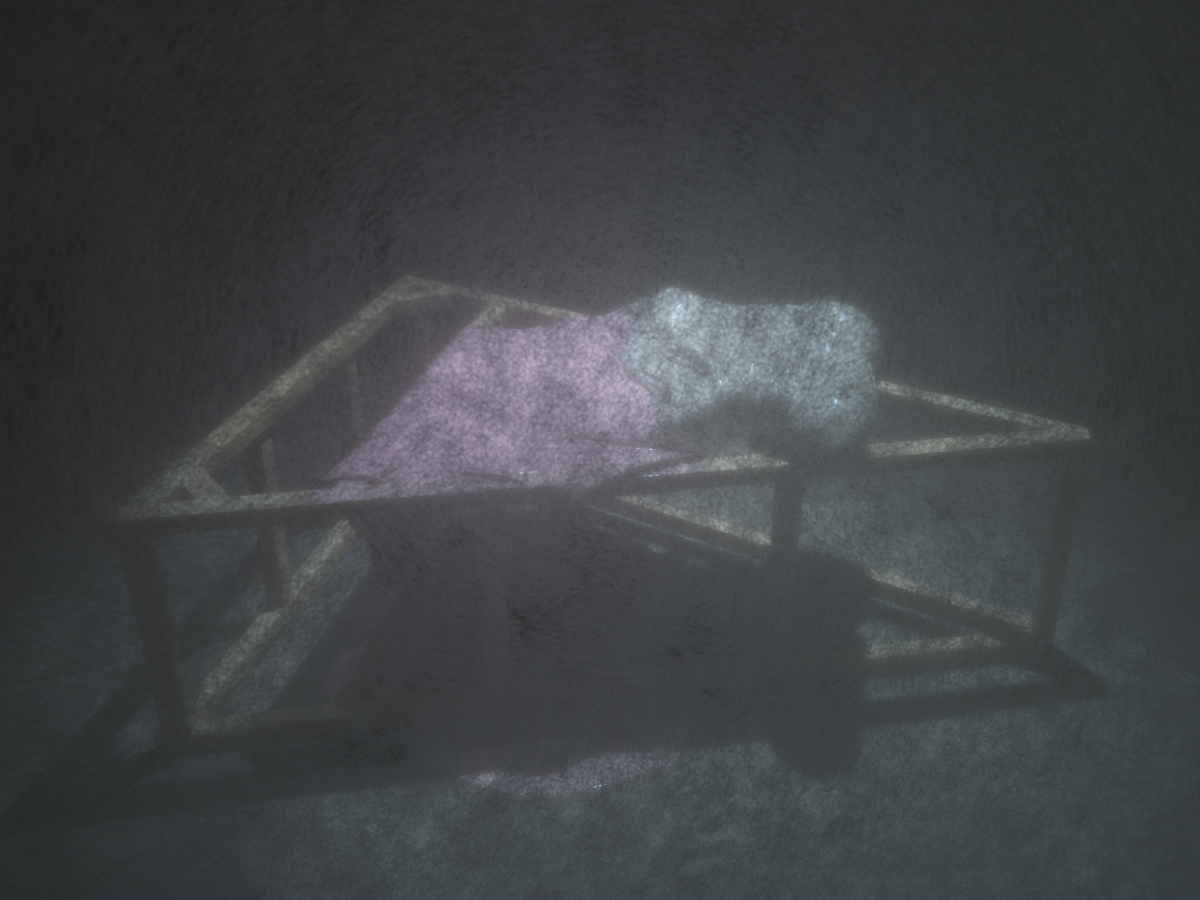
This text was originally published in the catalogue of the exhibition Tejka Pezdirc: Temporary Condition, which was on display in the lapidarium of the Galerija Božidar Jakac — Museum of Modern and Contemporary Art in the period 12 April – 14 July 2024.
The body is never at rest. Not even when we try to consciously control it. Even when it appears motionless on the outside, countless processes are taking place on its inside. These processes are manifested in a barely perceptible rise of the chest or the flickering of the eyes behind closed eyelids. Blood flow, cell travel, nerve impulses are just some of the invisible processes. After all, the body is constantly undergoing a cycle of decay and, to a certain point, regeneration, right until its final – and complete – collapse. All changes are short-term stops on the way. All conditions are merely temporary.
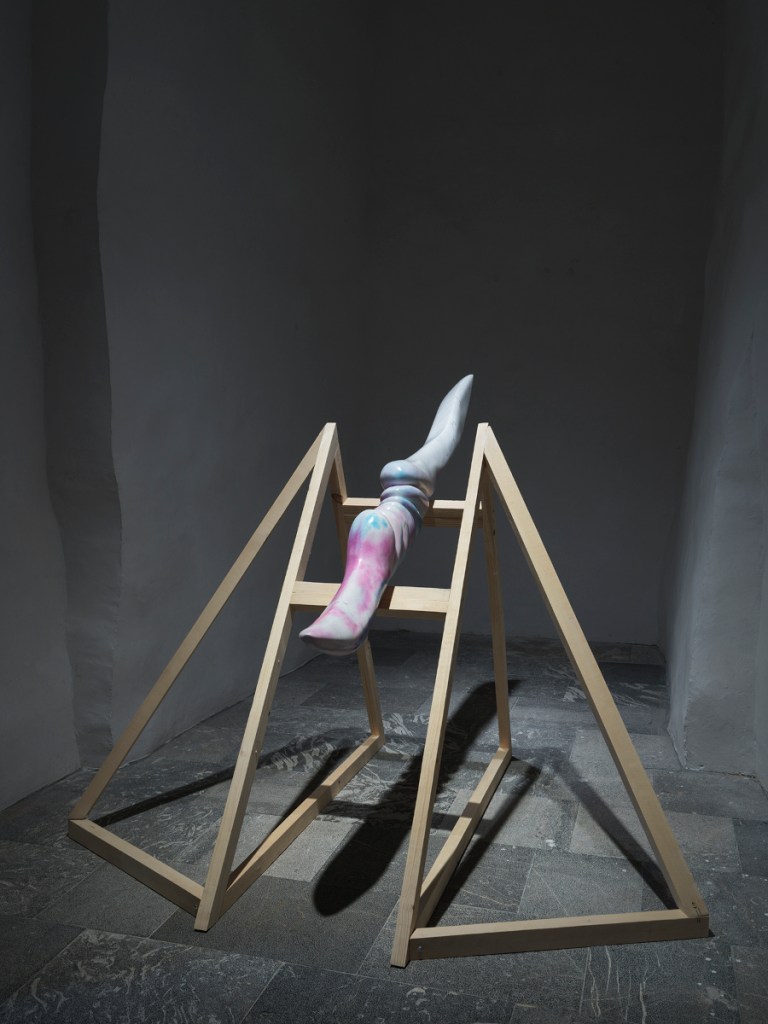
The installation in Tejka Pezdirc’s exhibition Temporary State in the Lapidarium at the Božidar Jakac Art Museum speaks about the fragmentation of the body, where we encounter its drive system. Stone organs such as our heart, brain or lungs are comfortably housed within stretchers – wooden skeletons that help keep the contents in their right place. They are surrounded by nerves and fabric. As within us, this system is intertwined and in a vitally important interdependent relationship. The sculptural practice of Tejka Pezdirc is based on relevance. She creates her sculptures with a layout that seeks confrontations with colours, materials, and light, but above all with the viewer’s gaze. The desire for a constant presence of contrasts is visible already in the stone sculptures themselves. Often, it is precisely the areas hidden from view of the seemingly simple stone forms that create the necessary tension in the form and are finished in greatest detail. Like living entities, they shrink and hide to show their hardest side; like wounded organisms that have wrapped themselves in a hibernation ball in order to recover from their traumas as quickly as possible. Others bare their most intimate parts and proudly show where it hurts. Despite the desire to reach suspense between the exhibits, they are shrouded in sfumato. Tejka Pezdirc’s creations exude tenderness. The choice of luminous and translucent textiles, the fusion of smooth silicone and dedicated attention to lighting, engulfs the layout in a cloud of softness that is unmistakably feminine.
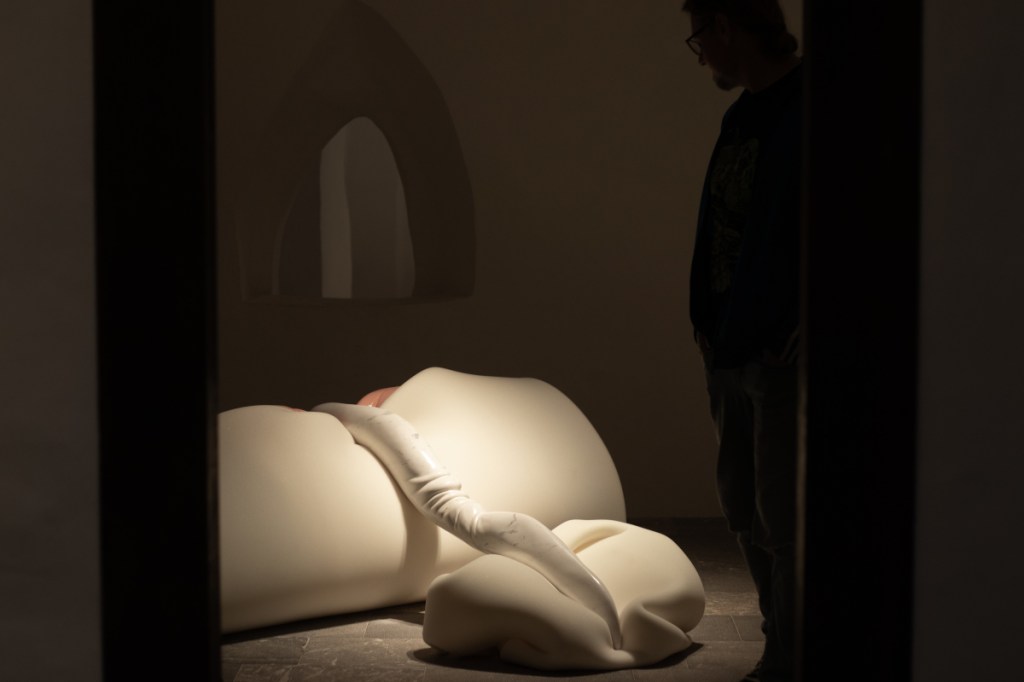
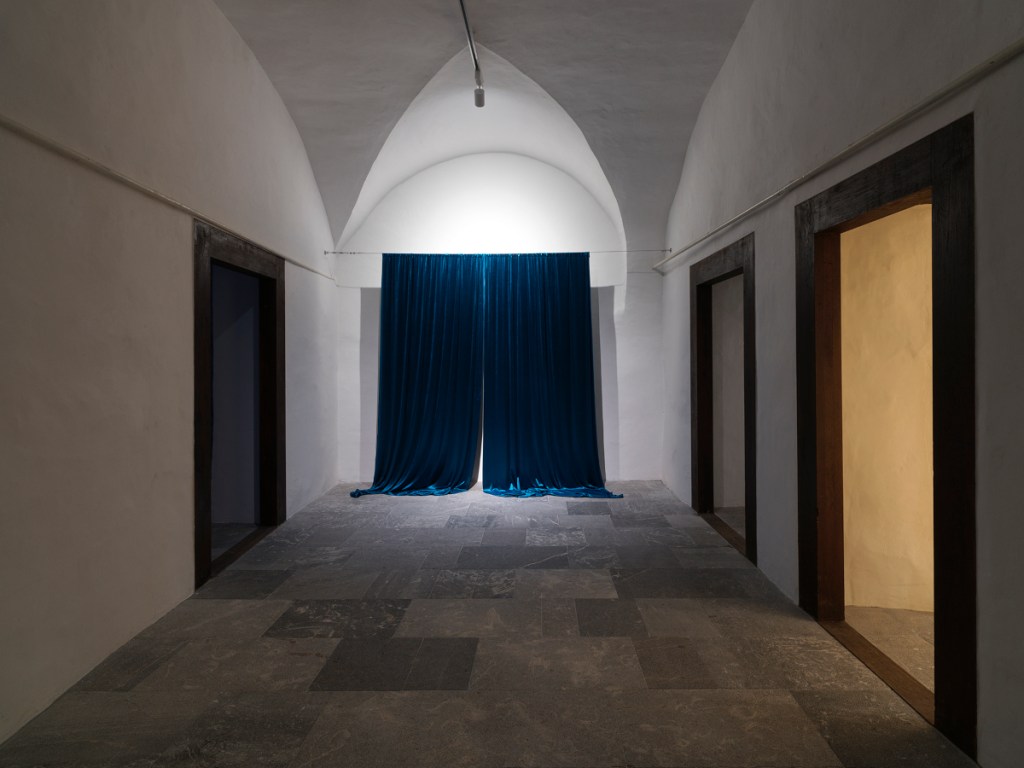
The body that the sculptor created for the Lapidarium is forcibly divided into four rooms, which further expand into smaller ventricles. Through interventions and the precise placement of objects within the space, she created relationships between the elements that communicate through the walls and show a desire to merge, which makes the body function as a single entity. With each transition to a new space, which is further interrupted by the descent to the outer corridor, the viewer is faced with a constant cycle of gain and loss. The repetition of elements and the way the author focuses the viewer’s gaze on the desired “frames” remind us over and over again of the missing parts, which cannot be replaced. Igor Zabel reflected on a similar experience when contemplating the artworks created by Marjetica Potrč. Her “walls” from the late 1980s (Abdomen, Legs, and Eyes in the Body, 1988), which, if not in their form, dictated the reference to the human body with their titles, first deceived the viewer with hidden tricks – the front side was not the same as the back, despite the symmetry that was suggested when viewed from the front. A completely different view awaited the viewer when viewing the artwork from the back. Igor Zabel described the Abdomen statue as a “trap for the gaze” for the viewer realized that the back side of the statue completely destroyed his concept of the original interpretation and described the experience as traumatic. The viewer had to face a “look of disappointment”, which comes from the realization that we cannot perceive space as unified and independent of time and that, as a result, we always experience our bodies as disembodied. When we see ourselves, we never see ourselves fully. The result is similar in the exhibition in the Lapidarium, except that in this case, we are not dealing with the matter of destroying the perception of one object, instead, we experience this while moving from room to room.
The holistic experience is also characterized by the way the segments of the body are named, for they are not separated into “pieces”. In most cases, the statues as independent exhibition objects do not have titles, as the titles are carried by the “rooms”. In the first room, called Behind the Folding Screen, we find ourselves in the role of a voyeur – we witness something we shouldn’t see. The membrane wall pushes us into the intimacy of a theatrically placed piece of meat. Pezdirc’s spaces often take on the feeling of a frozen staged scene a second after the climax of the theatrical play had occurred and the activity has moved backstage. However, in the case of the second room, it would be more appropriate to speak of an abandoned operating room or laboratory, in which samples in transit are being prepared for further procedures. The ambiences remain empty sceneries, and the dramatic light on a piece of stone or silicone transforms its role from an object to a subject. This also applies to the Hatchery and its imposing structure from which the stones crawl. The heavy drapery covers the platform as well as the floor like a waterfall, providing soft support for the implied movements of the statues. In order to make the specific spaces of the Lapidarium as friendly as possible for the sensitive matter, the artist often used overlays and coverings. In the aforementioned cases, they are still breathing with the newly inserted constructions, while elsewhere, e.g. in Ludvik’s room, they are drowning in streams of gold coating.
Even though the sculptress uses epoxy, silicone, textiles, and plaster, stone is her material of choice. Today, marble – the classic material of sculptors – is rarely represented in sculpture. This comes as no surprise, since modern sculptors have a myriad of justifiable reasons to avoid marble. These reasons range from practical ones such as accessibility and cost, to conceptual reasons, environmental concerns, and a tendency towards interdisciplinary approaches. Tejka Pezdirc is attracted to it precisely because of the discipline it demands. Even though her sculpting of the stone takes place impulsively and relatively quickly – according to the principle of the Phidian idea that the form is already hidden in the material itself and she feels the need to redeem it from its amorphousness, the final object still needs a lot of cutting, grinding and filing in layers. The dusty, dirty as well as physically demanding process, which remains virtually invisible to the viewer, is represented in the form of performances that symbolically illustrate the transformation of the stone.
On this occasion, a video performance concludes the exhibition in the darkness of the last room titled Under the Surface. Below it stands a piece embedded in foam, which we follow in motion with the sculptress on the video. In a short interval, they rise together above the surface of the water and complete the intense process of transformation – material and symbolic. In the ambience of the river Kolpa and the time loop that momentarily changes the flow of water in an unnatural direction, the process acquires the character of a ritual. The distorted noise accompanies the movement of the body and the surface, which brings a sense of unease and tension to the otherwise peaceful scene, which is deliberately also transferred to the other rooms. The sharp edge of the stone is about to pierce the soft surface, the light casts strong shadows on the ground and creates even deeper grooves in the statues. Let the experience “hurt a little,” says the artist. On the subconscious level, this probably echoes her frustration, which she experiences while sculpting, as the stone often dictates a shape that irritates her. She is aware that her subconsciousness is at work, thus she describes the process as intuitive and not necessarily random. She not only transforms the marble into organic forms, which, despite her desire to move away from recognizable forms, always develop into an association with the body, but also colours it.
Unlike the shaping of the stone, which she processes quickly (if we take the complexity of the procedures into account), she intervenes in it with a longer process of soaking and grinding. She does this for so long that the pigment settles into the stone as a deep bruise caused by the bleeding initiated from within the stone. As if the veins in the stone were irritated by the process and bled from the inside in shades of blue and pink.
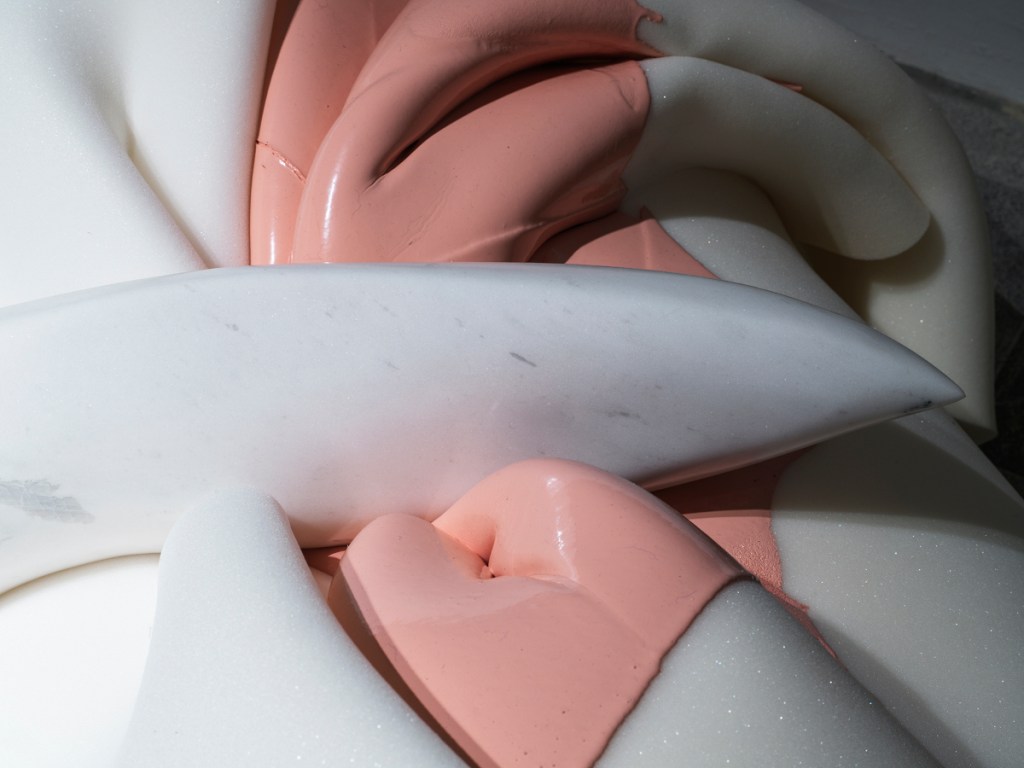
The contrast between the natural material and the artificial intervention of adding colour, which in the end still works like a stone picked up in nature, is only one of the principles of the artist’s exploration of contradictions. Her works are full of contradictions and deceptions. The hard marble folds into soft, fleshy rings. It is covered by a rubber blanket of skin, which becomes thinner at the edges and becomes increasingly transparent, falsely delicate, because the material does not allow any trace to be pushed into it. The seemingly solid structures are held together by a few nails, covered by a paper-like delicate fabric that acts like milky glass under the light. What is shiny and tight is the flexible rubber. The waterfall form made of sumptuous gold is a clumsy first aid foil. The deception of the viewer is of key importance as it tempts him to spend more time with the works and relate them to what he has already seen. Thus, the viewer perceives the repetition of forms and materials, but he himself plays the role of the main connecting element. By moving, he delivers oxygen to the limbs that need it.
Deja Bečaj, curator at Galerija Božidar Jakac – Musem of Modern and Contemporary Arti, Kostanjevica na Krki

