

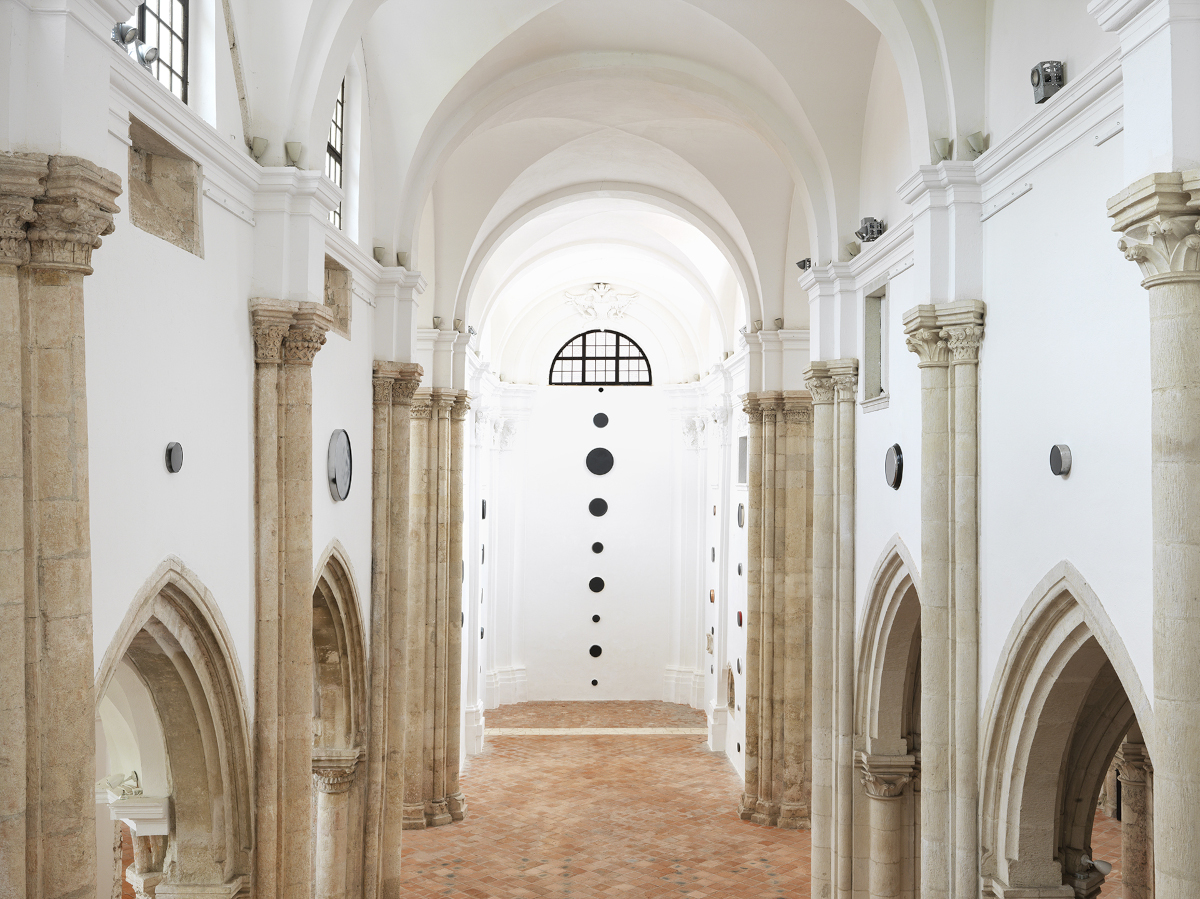
The text was originally published in catalogue of the exhibition of Vadim Fishkin: Dark Times that was on display in the period 5 May – 27 August 2023 in the former monastery church at Galerija Božidar Jakac – Museum of Modern and Contemporary Art, Kostanjevica na Krki.
What is time? A question that comes to mind as I write the accompanying text to Vadim Fiškin’s exhibition project Dark Times, as I am hunted by time as usual, as the date of the exhibition looms, while I calm my two children who are obviously bored and look at my wife trying to synchronise her inner time with the universe while she meditates. Do the four of us even inhabit the same time? Is it any savour at all that we are in close physical proximity to each other, in the same space? That we can see each other and confirm that we are here-and-now just because of light? Many scientists, especially physicists and philosophers, but also artists, have been dealing with the question of the space-light-time relationship for millennia, ever since they stopped believing that all these questions were in the hands of the gods on Mount Olympus. They began to observe, measure, connect and draw conclusions. And many still do so today. One of those is Vadim Fiškin.
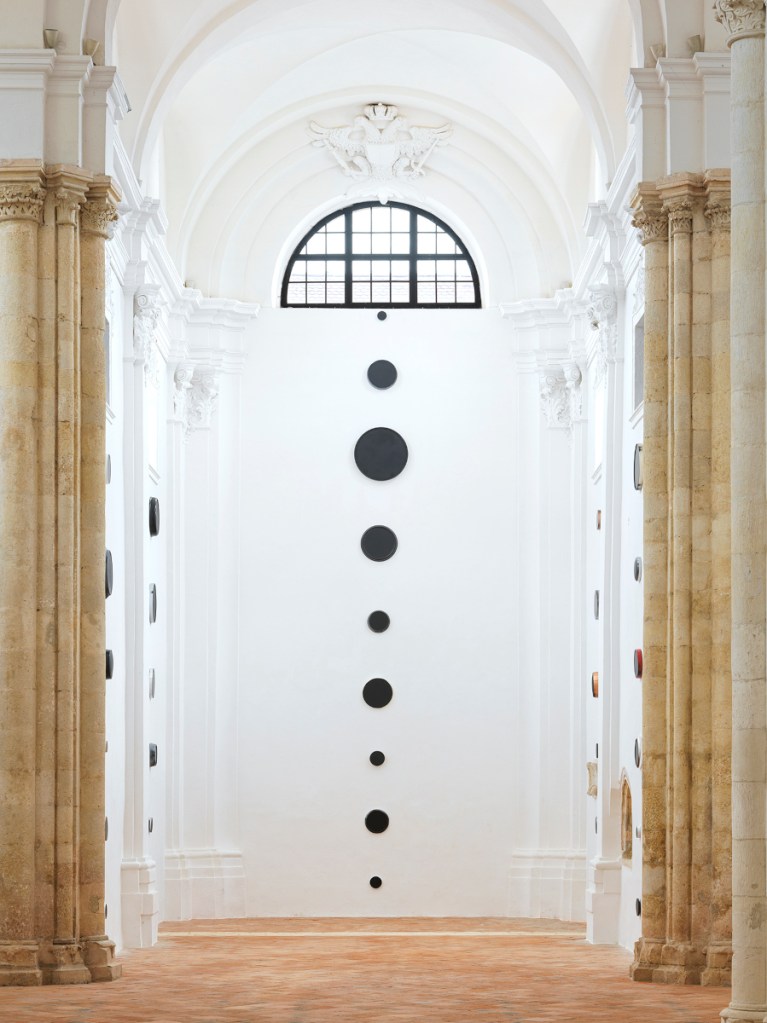
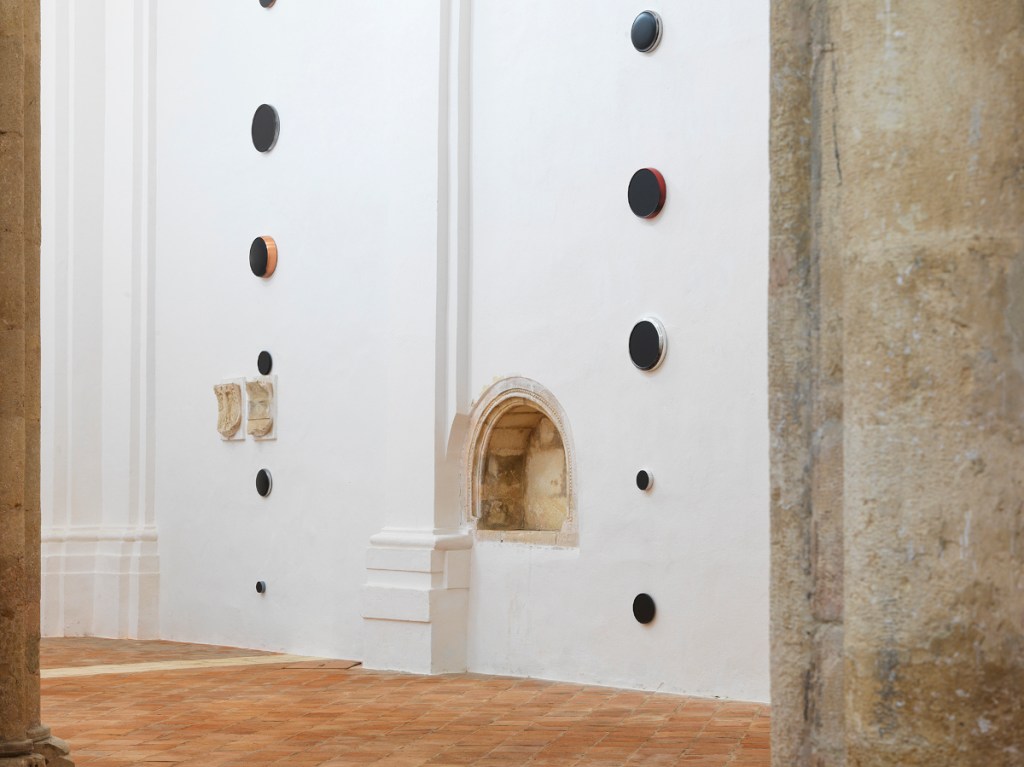
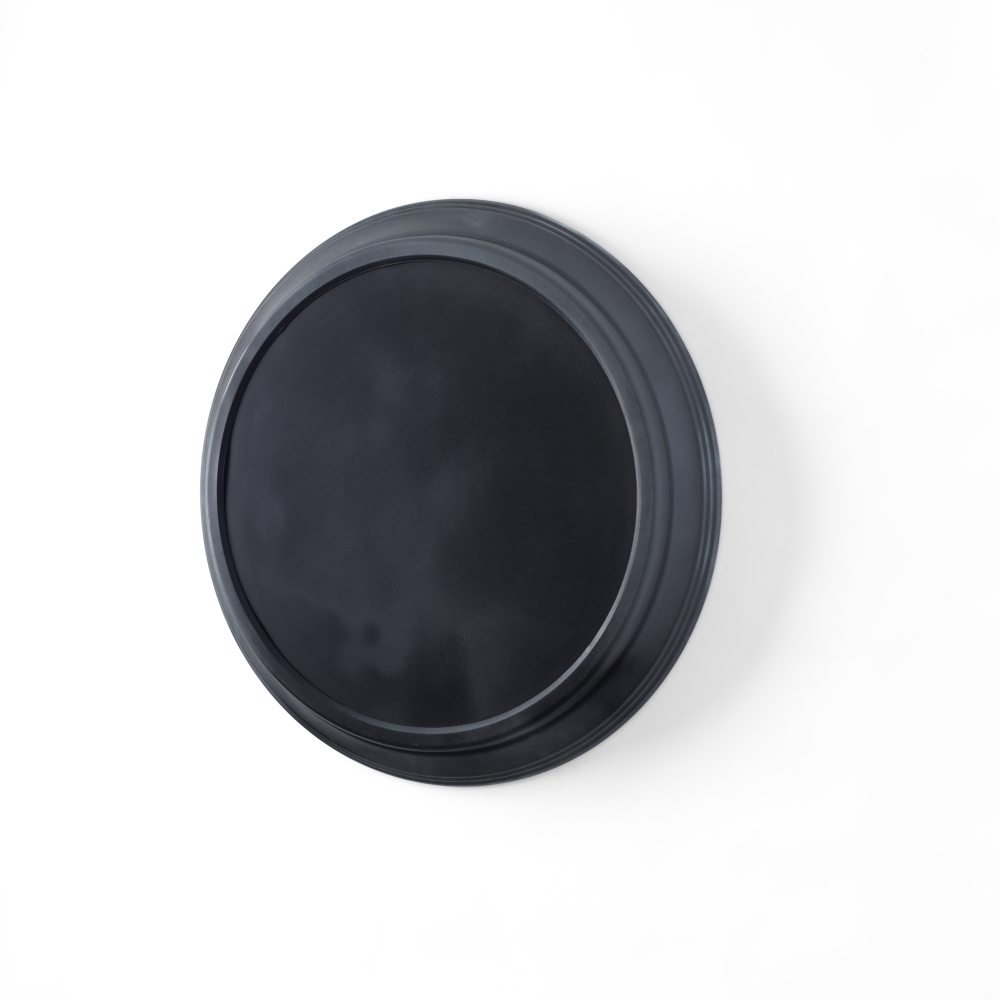
Fiškin’s exhibition at the Božidar Jakac Gallery continues and expands his creative exploration of the phenomenon of time, light and, indirectly, space. Inside the former monastery church, the artist creates a holistic spatial intervention with minimal visual and audio means, the central elements of which are the black-painted wall clocks and their endlessly repeating sound, either counting up or down or simply announcing itself as a tick-tock. When we talk about time, we usually mean the mechanisms and units by which it is measured. We think of seconds, minutes, hours, days, years; we think of intervals between from and to. Counting time also involves looking at the dial that sets off the ticking sound and determines how many intervals of the agreed ticking have been measured. So, the ticking sound instinctively calls up the gaze. But this kind of gaze is suspended in Fiškin’s clocks since the artist covers the clocks with paint. The black clocks can thus also represent something that symbolises nothing, like a Zen garden, which belongs to the art of emptiness. The gaze is thus suspended in the infinite, which is nevertheless not eternity since sound can be heard within it, which is either a mere fluctuation or time added or subtracted. This was also the question in The Confessions of Aurelius Augustine, who summed up his thoughts on time in this way: “If no one asks me, I know; but if I want to explain the question, I do not know. But I dare to say with certainty that there would be no past time if nothing were passing, no future time if nothing were coming, and no present time if nothing were present.” According to Augustine, although we measure time in the soul, the day is to us as a dimension of the soul, where at the edges into the past and the future, the images sink more and more into the dusk. This represented an important turn from the ancient (pre-Socratic) understanding of time, rooted in cosmology, to a subjective inner consciousness of time. Even though, Aristotle had already thought about the impossibility of the existence of time without a soul.
The nature of time is therefore a very complex question. So we have no choice but to try to slow down in explaining the definitions. Time was already considered by the Pre-Socratics, the earliest thinkers of ancient Greece, among them Anaximander of Miletus in 600 BC (who is said to have been the first to set up a sundial), who made “apeiron” the root and the first element of everything that exists. It is eternal, does not age and encompasses all worlds. It is a kind of infinite essence from which, according to Anaximander, everything emerges: “from that which things have come, in that they will also pass away – according to Necessity; wherefore they pay each other the penalty and compensation of the debt according to the order of Time”. Omnipresence and omniscience has the attribution of God. Time for him is the defined coming into existence, being and passing away (of living things). Here we see a linear or sequential (whence it came, therein it will pass away) interpretation of time, which is still the dominant cultural construct today. A few other cultures (e.g. Aztecs, Chinese) have a cyclical conception of time, which is still perceived in sequence.
As we can see, the tradition of Western philosophy, in its search for the theories of time, has always been linked to the fundamental question of being, since temporality determines that something was, is and will be. Plato follows this line. In Timaeus, he writes that eternity “corresponds, according to true thought, only to ‘is’. ‘Was’ and ‘will be’ are the appropriate utterances for becoming, which takes place in time.” Time is real for him insofar as it records on eternity. Time is the moving image of eternity, and eternity is the timeless present. Therefore, according to true thought, only ‘is’ corresponds to eternity. Aristotle also dealt a lot with time. One of his classic works, Physics, in which he also reflects on time, is still relevant today. According to Aristotle, time is inseparably linked to kynesis (change, movement). Time, according to him, is precisely movement, in relation to before and after. The exception, according to Aristotle, is the eternally existent, when it is the eternally existent that is not in time, since it is not circumscribed in time nor is its being measured by time.
To avoid a long philosophical debate about time, we will briefly move to the beginning of the 20th century, when Albert Einstein developed the theory of relativity, first by publishing a special theory of relativity in 1905 showing that space and time are intertwined, and then a general theory of relativity in 1915, which he linked to the effects of gravity. Physicist and philosopher Sašo Dolenc has written about this in great detail in Kvarkadabra, the online journal for the interpretation of science. In a nutshell, Einstein found that time changes at a rapid rate, that it is inseparable from space, that it is affected by gravity, and that it does not flow in the same way for everyone. Through calculations, Einstein developed the scientific theory of the fourth dimension that we cannot perceive, see or traverse. Even Stephen Hawking, one of the world’s leading physicists who studied the origin of the universe and the black hole, is reported to have once said wryly: “It is impossible to imagine a four-dimensional space. I already have enough trouble imagining three dimensions”. Einstein’s Spacetime is an example of a four-dimensional space in which there are four directions of possible motion in length, width, height and time. We cannot imagine this with our senses, but this would mean that we could see a person’s life from birth to death as a single four-dimensional object. In his essay Science and the Philosophy of Space, published in volume 247 of the Journal for the Critique of Science, Dolenc writes that Einstein’s theories, bizarre at first sight, that time flows differently for different observers and that space can curve, have attracted the interest of the masses. Especially after astronomers confirmed that phenomena such as those predicted by Einstein can actually be observed in the sky. In his article, Dolenc cites an interesting incident, when two influential scholars confronted each other on the premises of the French Philosophical Society in Paris in 1922. Henri Bergson, one of the most important scientists and the most famous philosopher of the time, and Albert Einstein, who was revered as a giant of science. Bergson argued, writes Dolenc, that relativity was first and foremost a physical theory, which meant that its claims about the nature of space and time referred to the space and time of physics and not to the general treatment of these concepts. To this Einstein replied that the time of philosophers did not exist. Einstein’s assertion meant that philosophical theories of time and space are mere quibbling. As he explained, for him there are only two concepts of time: the physical and the psychological. Physical time is that which is measured by clocks, while psychological time is merely a sense of duration that is perceived differently in different circumstances. You can imagine that Bergson and Einstein never again debated together in public.
In a symbolic sense, time is often also a marker for social norms and the political-historical context. Thus, time is transformed into capitalist time, dark time or uncertain time. We can have a whale of a time and think of it as the golden times. Or it makes itself felt as seasons, old times (memories) or new times. It may also drag or fly. The latter is my favourite because it supports what society needs most today – creativity. It is paradoxical that in the age of digital time, we are losing out in this area. Thomas Hylland Eriksen, for example, writes in his book The Tyranny of the Moment that the times are over when people felt the need to acquire as much knowledge as possible. It was necessary to listen to as many lectures as possible, watch as many films as possible and have as many books as possible on the shelf. Today, on the other hand, the intellectual’s goal is to have as few books as possible on the shelf, to see as few films as possible and to listen to as few lectures as possible. In general, he aims to streamline his media consumption as much as possible. There is no longer too little, there is simply too much information. In this flood, there is no guarantee that a page or a piece of information available today in the predominant digital medium, the web, will still be there tomorrow. The fleeting nature of information and its permanence is thus taken to extremes, and with it, the culture of dialogue and long debates is also slipping away. We live in a time when texts like this are produced with the help of artificial intelligence. But not this one. Perhaps it is because I come from the old days and believe that both philosophical and physical science often arrived at all the insights I mentioned earlier in the text precisely through long disputes and errors in theses or calculations, which then led to new, revolutionary theses. Tools like ChatGPT and similar will have problems with just that. This is why I do not trust them. Time will tell, of course, whether I am right.
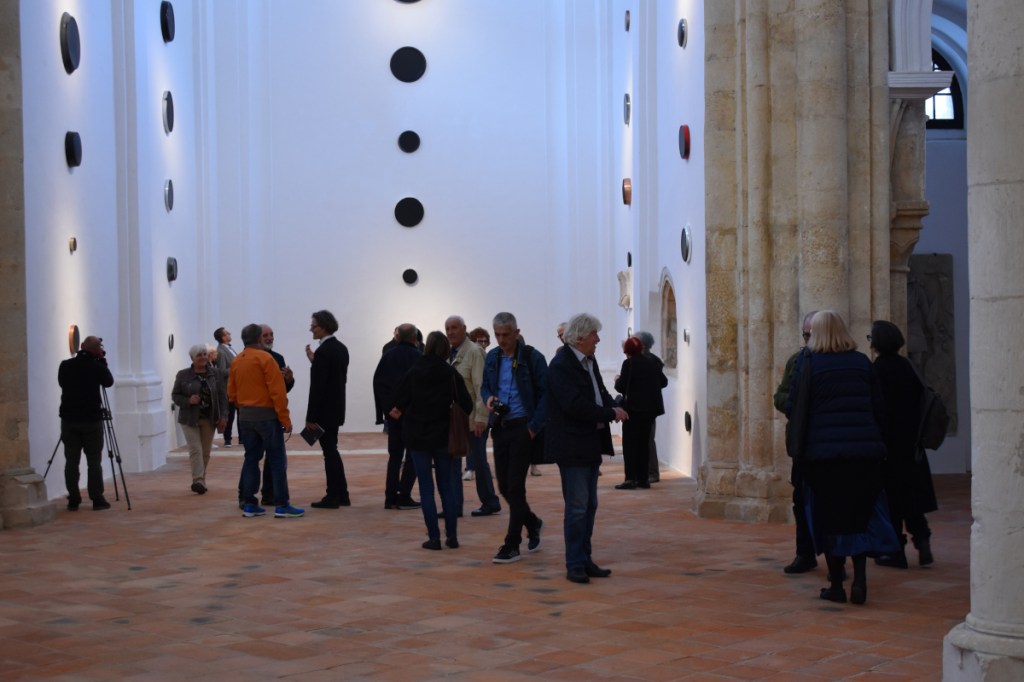
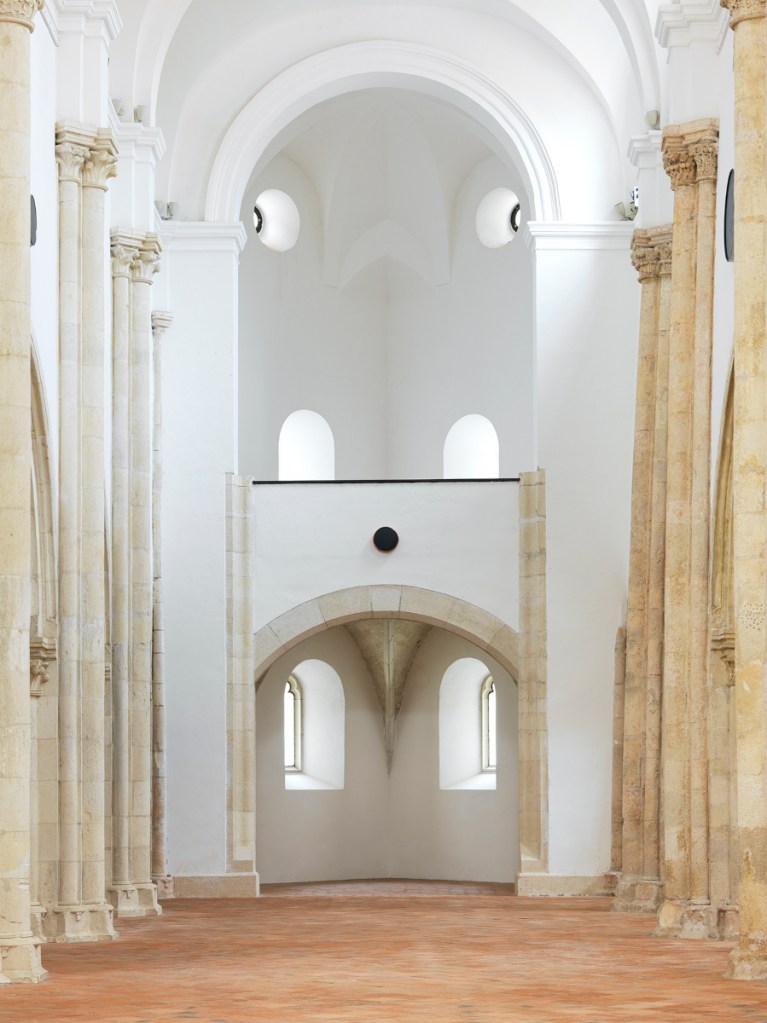
Vadim Fiškin has prepared 95 clocks for the project in the former monastery church, akin to the 95 theses of Luther. Most likely, not all of them will be exhibited in the space, which does however not necessarily mean that they will not be present. Each of Fiškin’s black clocks is a portrait of itself, bearing the attribution of the individual, the one, the unique. But it coexists, along with others in the space. It tries to speak to others, position itself in society, be loud, be visible. But it only succeeds if the clock society functions as a whole. A clock society that can also be seen as Einstein’s theory of space-time. The former monastery church of the Božidar Jakac Gallery, whose bell tower has no clock, thus becomes a hyperspace through the placement of all Fiškin’s clocks and appears as a single four-dimensional object.
Goran Milovanović, curator of the exhibition and director of Galerija Božidar Jakac.

