

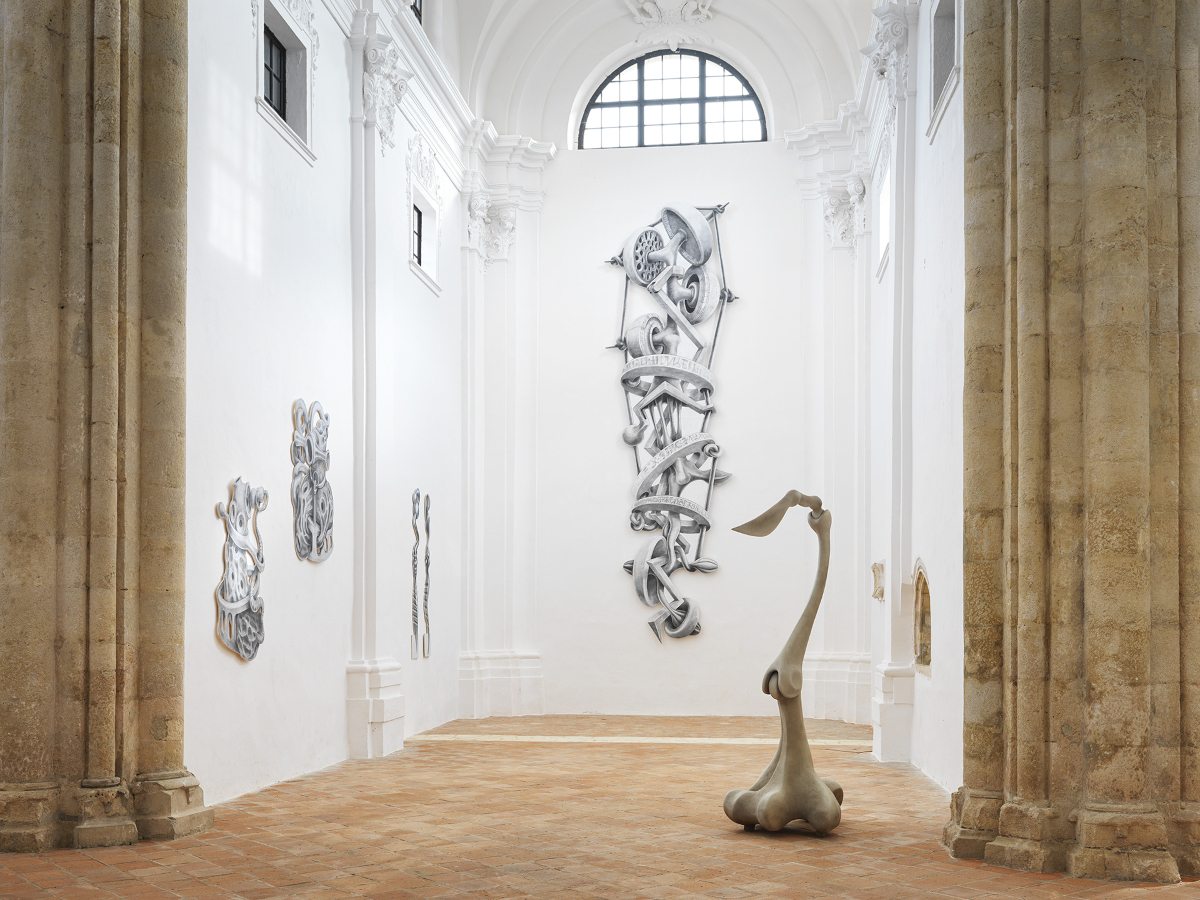
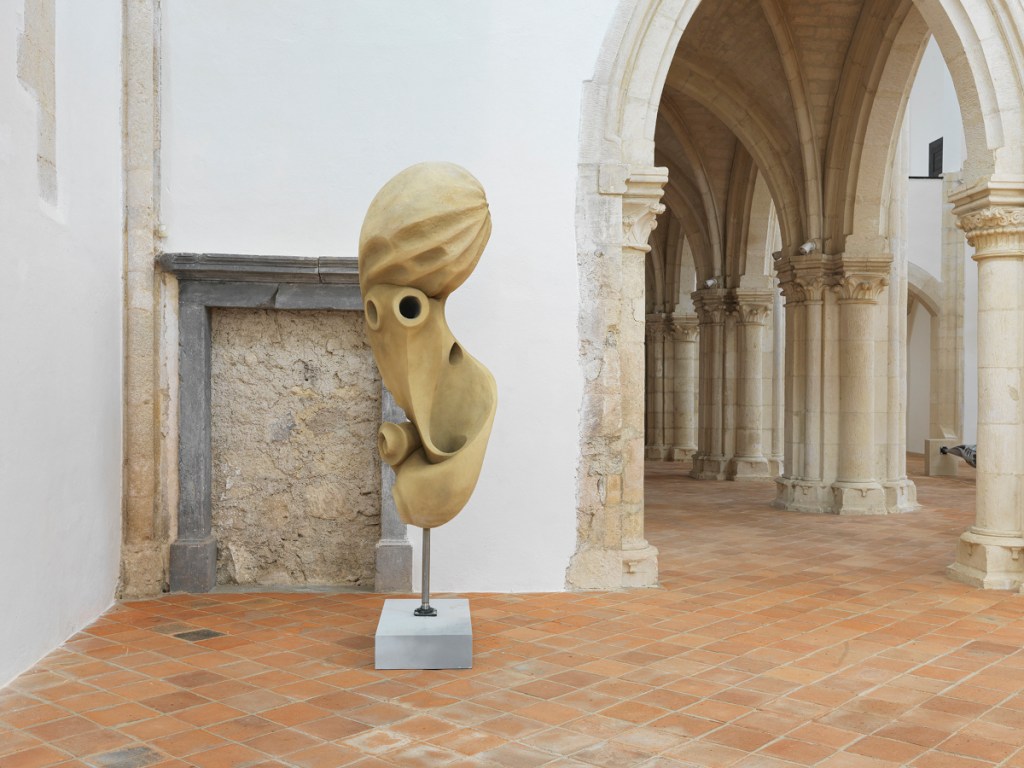
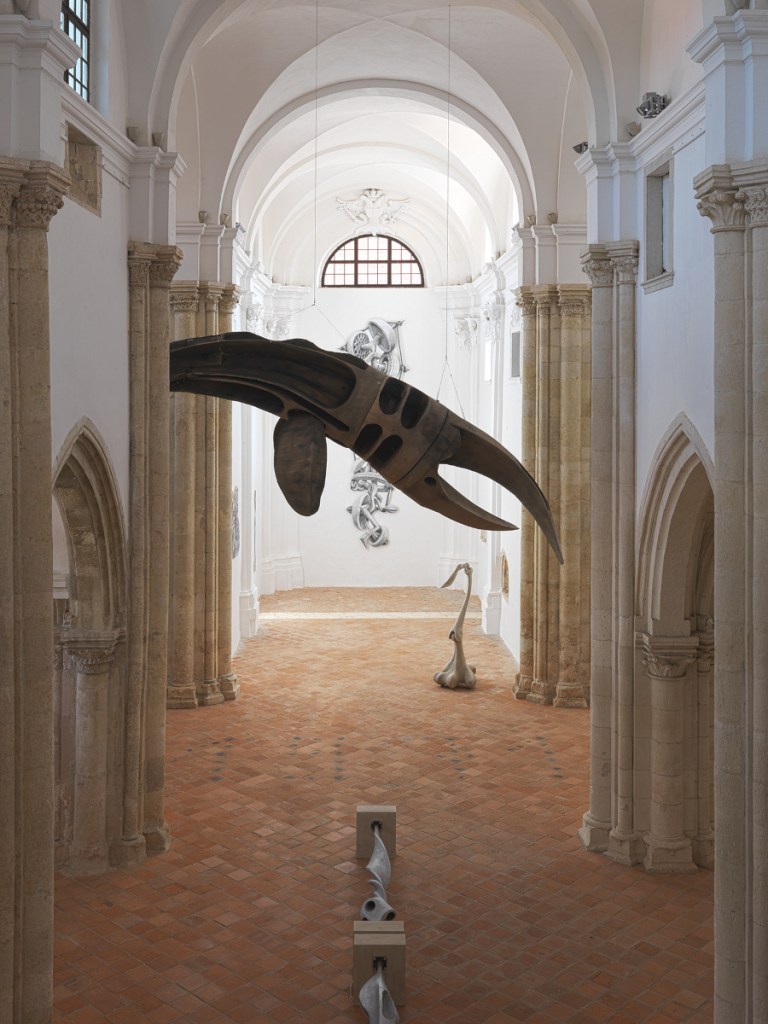
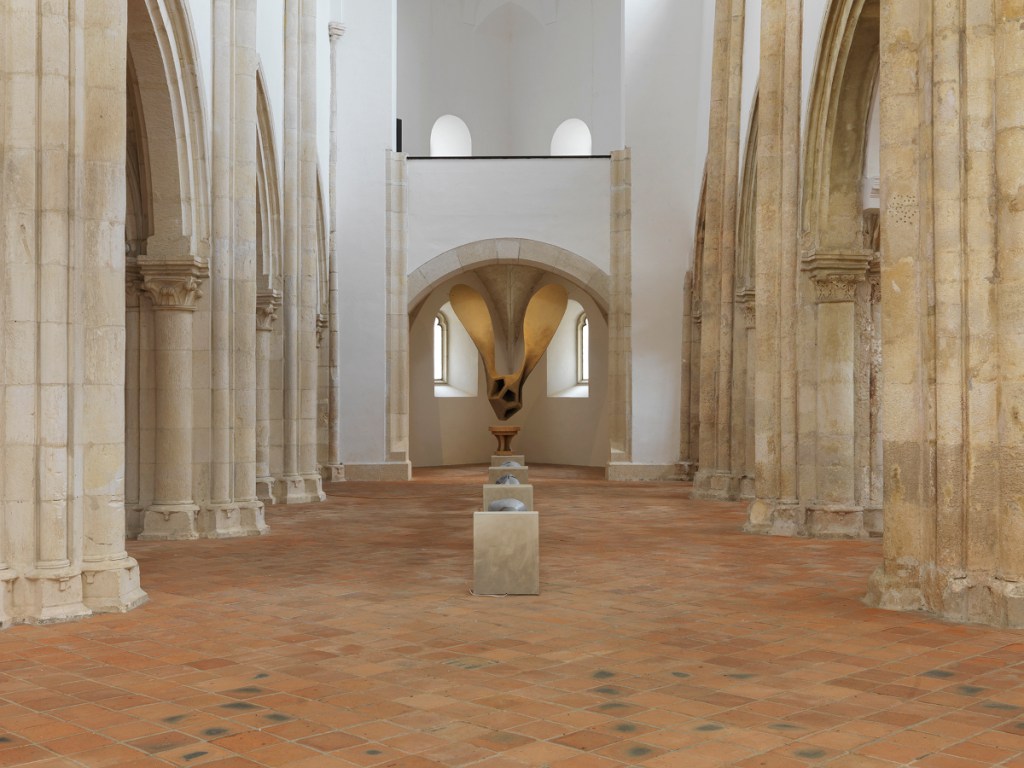
The text was originally published in catalogue of the exhibition of Damijan Kracina: Wrong Ship that was on display in the period 29 September 2023 – 3 March 2024 in the former monastery church at Galerija Božidar Jakac – Museum of Modern and Contemporary Art, Kostanjevica na Krki.
The exhibition Wrong Ship, created by the artist Damijan Kracina, tells a fictional story about human progress and our ability to survive and reinvent civilisation over and over again. It presents a subjective view into the potential futures of society and the planet and reflects on the rapid progress and the ability of the human species to conquer our surroundings. That is why the interpretations of his integrated work focusing on the future are completely open, multifaceted, and undefined, and the present story is only one of many. However, any resemblance to reality is undoubtedly accidental.
Throughout the history, humans have often believed things were much better in the past and that once upon a time there were elegant, if perhaps rather primitive and simple, solutions to all problems. And yet society has finally outgrown this platitude. From the perspective of geological history, it really was much better in the past (as well as worse, depending on the period). During the period of modern and advanced civilisations, after long-term mining, extraction, refining and monetisation of a wide variety of resources, the planet has become almost unfit for life (for the kind of life that people knew and wanted to live). And yet, given the situation, the planet lasted quite a while.
Historians have established that humans have successfully managed the planet for thousands of years. The exploitation and burdening of the environment began a long time ago, in the time of the first known civilisations and communities, when people, in their desire to obtain arable land, burned forests and cut down plants to feed the need for material growth and to obtain sufficient supplies for an ever-growing population. Eventually, the number of people on the planet increased so drastically that the general consensus became that there was no going back. Not even cataclysmic wars, pogroms, famines, floods, earthquakes and epidemics have eradicated enough people to establish a sustainable balance. Everyone continued to constantly desire more and more. And in a society where everyone wants the same thing – material success and fame – apparently nothing can change.
The economic logic behind endless progress demanded a few percent more of everything every year, because this is absolutely necessary for a high-quality of life expected by humans. Power structures linked into nation-states and corporate kingdoms needed more and more people to feed their own interests. Dogmas need followers to justify their existence. On the other hand, a general culture was formed throughout history that dictated the principle according to which everything can be measured only by monetary means, while other immaterial and virtual values ceased to exist by decree. Antisocial behaviour also began to be controlled; people who did not appreciate success and the possibility of owning more and more, and those who did not master business behaviour, were considered dangerous sociopaths who, for their own good and the safety of society, were either placed into institutions or into home care. Reportedly, many still successfully hid in society and pretended to be normal.
In such an environment, everything began to run out. As society switched to using cleaner energy, it firstly stopped mining coal, then pumping oil. Then, due to the lack of clean and renewable resources and further increases in the population, coal mining and oil extraction began again, with the aim of creating clean energy, despite the losses in the process. When this ran out, anything from artificial substances to biomass began to be used as fuel. The world had become a hotter place and almost burned as a result of these interventions. Temperatures rose, deserts expanded, and ever-increasing areas of the world became uninhabitable, however, despite all these changes, people could not give up their habits and vices. One of the widespread dogmas was that the world will one day be completely destroyed by the human activities and that no life will be left on this planet. But the world continued to stubbornly exist.
Although history suggested that humans were primarily at risk because they had high needs and high consumption, while many other living beings survived easily with more modest consumption of resources, the dogma persisted through the generations. Of course it did. Humanity, in the process of ruling the planet, managed to destroy many animal and plant species, but not all of them. Some of the most successful survived and were perhaps preparing to rule the world after the final departure of humans, however the process of devastation was not yet complete. The instinct was simply too strong. There is still time for people to leave nothing behind. But time was running out, so it was necessary to start believing in a bright future.
For the sake of unstoppable decay and the lack of goods that could be consumed, the great magi, the managerial class, who must have demonstrated genetic superiority at the level of unbridled production and consumption, decided that humanity – when the ideal time finally arrives – would leave the planet in a coordinated manner and try its luck elsewhere, possibly on a large celestial body, which inadvertently hides sufficient raw materials in its bowels for the long-term wasteful life of billions of (former) earthlings.
Such an undertaking requires an enormous fleet, a vast armada of spacecraft that would enable the great migration; if it proves to be impossible to evacuate everyone, at least those who are most successful or genetically superior in achieving monetary success will be saved. A problem still unspoken in public, however, was the dwindling mental capacity of people who spent most of their mental activity thinking about material success and social status. Both were acquired mainly through the transactionally measurable activities of accumulation of material goods, while all unprofitable activities were set aside.
The brain is like a muscle – if it is not used, it shrivels and dies. This supposedly happened to the humans for the sake of the complete commodification of life; automatisation of the simplest thought processes, truncation of memory and dependence on constant sensory impulses. So, people became relatively stupid, ignorant, cretinoid and without any sense of humour. However, this is probably not the optimal moment to leave the planet, as it is not advisable to travel through space without appropriate knowledge. Regardless, the great magi decided to do this, and those who know how to create added value are usually not wrong.
It is for this reason that practically all preparations for an easier and more comfortable life were created in the past, while innovations according to the state of things were rare and even when they did appear, they were questionable. It is said that they have been created exclusively for future seekers of a new and better world. A long time ago they began to build vessels that were supposed to enable a more or less comfortable survival in the infinity of space. Therefore, they have to be equipped with everything that will enable travellers to survive – in addition to basic goods, they also need to include things to pass the time and relive the memories of what they left behind.
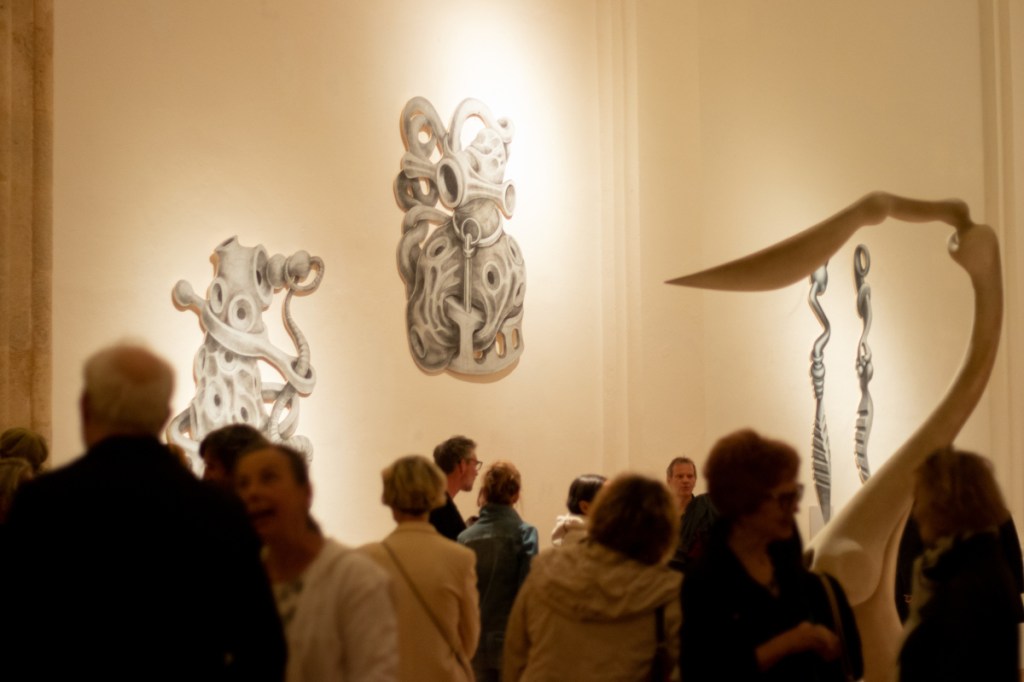
The vessels for leaving the planet have been preparing for their final mission for many years, one might even say for entire generations. They became seemingly more and more complex, equipped with advanced technology and organic remains of the earth, but they still remained on the planet. People or future tourists, following the instructions of the leaders, competed in collecting and bringing new necessities to the vessels, many of which had already been enlarged and expanded several times in order to host all the necessary things and people. Nevertheless, they could not know whether the spacecraft would fly at all and whether they would be able to penetrate the Earth’s membrane. The great magi claimed that they would when it was truly necessary, but no one had attempted it for a very long time. The time of departure thus remained in the indefinite future for many years, indeed generations.
This is one of the many prepared ships of this type, which have been parked practically everywhere in the world for a very long time. Despite the unknown departure date, the vessel is equipped with things that passengers or future tourists might need on the way. There are mountains of technical gadgets and apparatuses that everyone is convinced work smoothly, even though no one (still) living has ever tested them. There are also many facilities that serve entertainment, passing the time, education or indoctrination and preserving the memory of the heroic but primitive past. Many gadgets and facilities have been there for so long that no one really knows what they are for, how they work and what they mean.
There are large engines, which are said to allow the flow of all necessary substances for survival, and engines which, when gas is added, would supposedly propel the vessel into motion. Here are the devices that are supposed to make it possible to grow food in space, which will supposedly never run out, a self-regenerating organic-inorganic mass. There are some useful animals and plants that have already mutated in the wake of impossible climatic conditions and changed living conditions to such an extent that they are presumably adapted to life in artificial environment. There are also fossil remains of dead animals and plants, which testify to the former principles of life on earth. There are also mighty maps of the universe and plans of the vessel’s interior, which could be helpful if repairs to the complex systems were necessary.
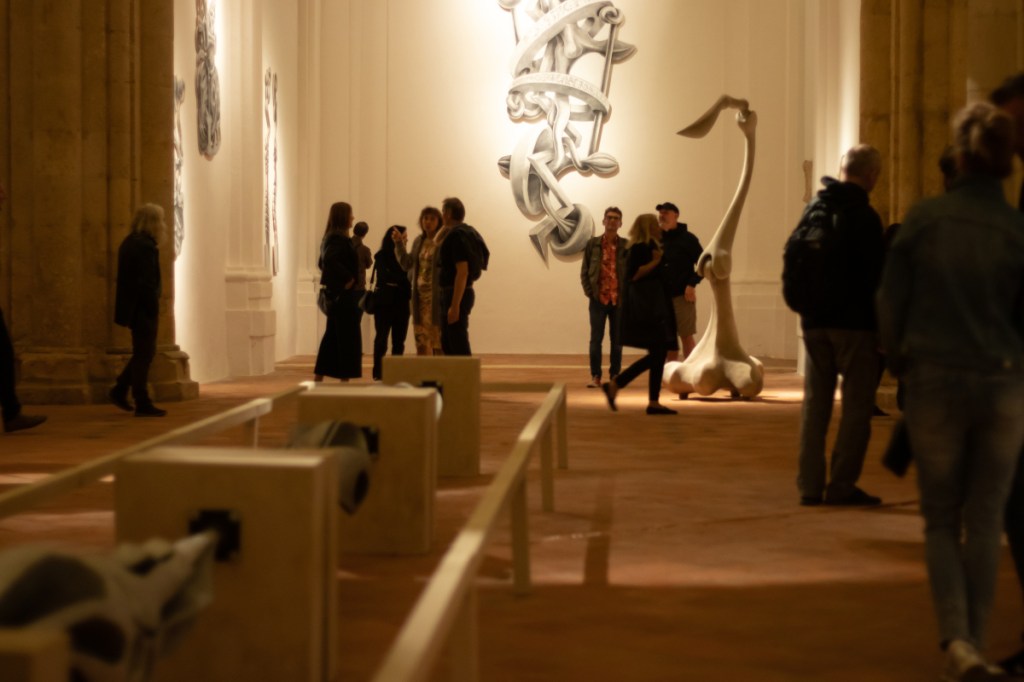
There are also some older structures for which there is no longer any historical memory of what they were supposed to serve, but instead they function as an integral part of the entire organism of vessels; these are large wings, moving formless masses, and some technologically enhanced organisms that no one knows anymore whether they are figments of the imagination or actual remnants of the past. Everything on the vessel should have its own function, as the transaction-oriented society has – for many years – avoided useless things that may have only a symbolic value. Undoubtedly, people also gave up art a long time ago, as it became completely unbearable in its indeterminacy and ambivalence.
However, the vessel – like all other vessels around the world – is still parked and anchored on a planet that is slowly but steadily falling apart and becoming more and more unbearable and useless for its inhabitants, especially humans. The departure hangs in the air all the time, but as the great magi say, the time for it has not come yet. There are still opportunities to produce and consume some of the resources left on the planet. It is believed that it is necessary to consume everything that is available before the departure, and only when there is nothing left to use and consume, people, or future passengers and tourists, will finally populate the ships and set off on a journey into the unknown. It is assumed that to a better world, where nothing will ever run out, where it will no longer be necessary to work for basic necessities, where there will be no more production, but only consumption. An ideal world for every sane earthling. Absolute nirvana.
In anticipation of this great day, order and discipline are important above all, as well as unconditional faith in a better world to come; only then it will be possible to forget all the brilliant solutions of the past. In a competitive society where people are natural competitors with each other, there is no room for doubt. To doubt the fact that humanity lives in an ideal society, which only needs to change the living environment for the sake of final perfection. There is no room for doubt that the constant progress may already have come to an end. And ultimately, there is no room for thinking that the vessel, which has been preparing for its final and irreversible departure from the devastated planet for many years and generations, is the wrong ship.
Miha Colner, curator at Galerija Božidar Jakac

